| Display title | Quintuplets |
| Default sort key | Quintuplets |
| Page length (in bytes) | 866 |
| Namespace ID | 0 |
| Page ID | 212 |
| Page content language | en - English |
| Page content model | wikitext |
| Indexing by robots | Allowed |
| Number of redirects to this page | 0 |
| Counted as a content page | Yes |
| Page image | 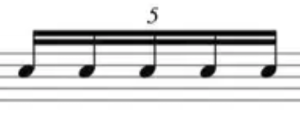 |
| Edit | Allow all users (infinite) |
| Move | Allow all users (infinite) |
| Page creator | Niggamario (talk | contribs) |
| Date of page creation | 10:56, 10 July 2026 |
| Latest editor | Niggamario (talk | contribs) |
| Date of latest edit | 10:57, 10 July 2026 |
| Total number of edits | 3 |
| Total number of distinct authors | 1 |
| Recent number of edits (within past 90 days) | 3 |
| Recent number of distinct authors | 1 |
Description | Content |
Article description: (description)
This attribute controls the content of the description and og:description elements. | A quintuplet (or a five-tuplet) is a tuplet consisting of five notes of equal length, typically used against 4 beats as a 5:4 polyrhythm. It’s regarded as the second building block when learning polyrhythms right after 3:2.
It’s also the basis of quintuplet swing, where the main grid is subdivided... |
